
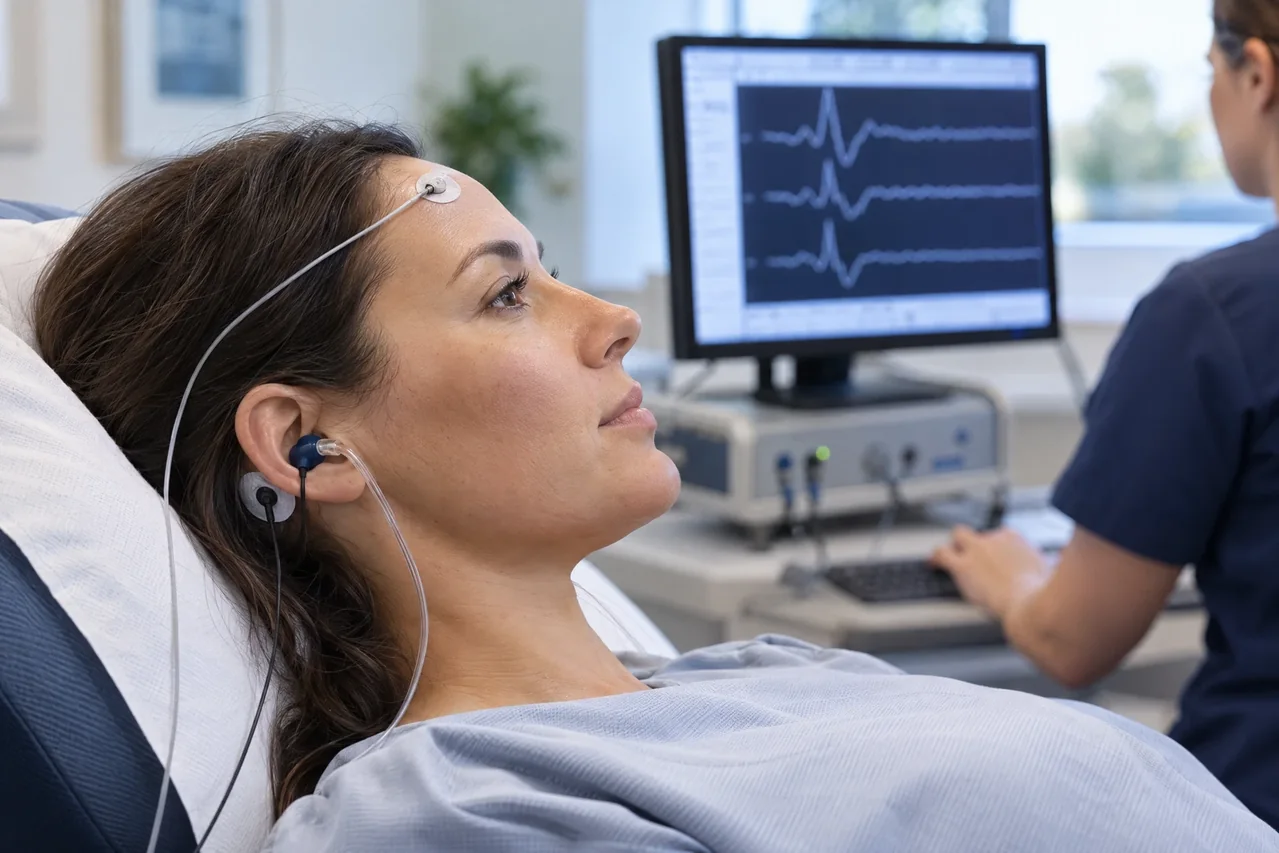
What neurodiagnostic testing can tell a clinician.
Neurodiagnostic studies record electrical activity from the brain, nerves or muscles, or the nervous system’s responses to a controlled stimulus. Your healthcare professional may request a particular study to add information to your history, examination and other tests.
A test recording does not explain everything about your health. An appropriately licensed healthcare professional considers the findings alongside your clinical circumstances and explains what they may mean for you. This website cannot provide an individual diagnosis.
Electrodes record electrical signals.
A surface electrode is a small sensor placed on the skin or scalp. Depending on the study, it records very small electrical signals or is used as part of controlled electrical stimulation. Recording electrodes themselves do not send electricity into the brain.
Needle EMG is different from a surface recording: a fine needle electrode is placed into selected muscles to record muscle activity. It is performed by an appropriately qualified, licensed healthcare professional within the relevant clinical arrangement.
Different studies, different experiences.
During EEG, electrodes are placed on the scalp to record brain electrical activity. You may be asked to open or close your eyes; other procedures, such as controlled breathing or flashing lights, may be used when appropriate. The testing team explains the planned protocol.
Nerve conduction studies use brief electrical stimulation at selected locations and electrodes on the skin to record responses. The stimulation may feel like a tapping or brief shock and can be uncomfortable. Needle EMG may cause discomfort during insertion and muscle activation; experiences vary.
Evoked potentials examine responses to a controlled stimulus. A visual study may involve watching a checkerboard pattern, an auditory study may use sounds through earphones, and a somatosensory study may use brief electrical stimulation of a peripheral nerve. The study selected depends on the clinical question.
Prepare with your testing team’s instructions.
Follow the instructions supplied by your ordering or testing healthcare professional. Clean skin—and for EEG, clean hair without styling products—may help electrode application. Ask the team whether any study-specific preparation is needed.
Do not stop or change prescribed medication, sleep, caffeine, meals or other routines based on this website. If preparation involves sleep restriction or another change, obtain specific instructions from your clinician. Share relevant medical considerations with the clinical team through their established secure process, not through this public website or general email.
Questions and comfort matter.
Ask what the study involves, which sensations may occur and how to communicate concerns during testing. The team can explain options appropriate to the protocol and your circumstances. No website explanation can guarantee a painless procedure, a particular duration or a specific outcome.
Results, timing, clinical interpretation and any next steps are explained through the responsible healthcare professional. This website does not offer direct patient booking, insurance verification or an emergency service. For an emergency, contact local emergency services rather than email.